Signed in as:
filler@godaddy.com

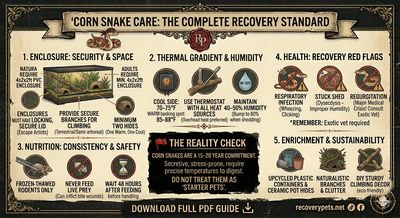
• Space: While juveniles can start in 20-gallon tanks, adults require a minimum of 4x2x2ft enclosure to allow for natural movement and proper thermoregulation.
• Security: Corn snakes are escape artists. Enclosures must have a locking, secure lid. They are terrestrial but enjoy climbing, so provide secure branches and sturdy decor.
• Hides: A minimum of two hides (one on the warm end, one on the cool end) is non-negotiable.
• Gradient: Cool side: 70–75°F. Warm side (basking spot): 85–88°F.
• Control: Use a thermostat with all heat sources to prevent thermal burns. Overhead heat (Deep Heat Projectors or Ceramic Heat Emitters) is preferred.
• Humidity: Maintain 40–50%. During shedding, this can be bumped slightly to 60%. Use a digital hygrometer/thermometer, not the inaccurate analog sticks.
• Frozen-Thawed Only: Always use humanely euthanized, frozen-thawed rodents. Never feed live prey, which can inflict life-threatening bite wounds on your snake.
• Schedule: Juveniles: every 7–10 days. Adults: every 14–21 days.
• Handling: Wait 48 hours after feeding before handling to prevent regurgitation.
• Respiratory Infection: Wheezing, clicking, or open-mouth breathing indicates an infection, often from poor ventilation or low temperatures.
• Stuck Shed (Dysecdysis): A sign of improper humidity. Never "peel" the shed; address the environmental humidity first.
• Regurgitation: This is a major medical crisis. If a snake regurgitates a meal, do not feed for 10–14 days and consult an exotic vet.
• Upcycling: Use clean, food-safe plastic containers or repurposed ceramic pots as secure, easy-to-sanitize hides.
• Check our Starter Kits & Fundraiers page to see how we turn recycled materials into premium snake habitat components.
Corn snakes are a 15–20 year commitment. They are secretive, stress-prone, and require precise temperatures to digest food properly. Do not treat them as 'starter pets'—they are living animals that require specialized, long-term care.